Roman coin denominations: a UK detectorist's quick reference
Denarius, sestertius, antoninianus, nummus. The four Roman denominations that account for almost every Roman coin found in Britain.
Roman coinage in Britain ran from the conquest in AD 43 to the withdrawal in AD 410. Four denominations account for almost every Roman coin a UK detectorist will dig in their lifetime: the denarius, the sestertius, the antoninianus, and the late-Roman nummus. Here’s how to tell them apart.


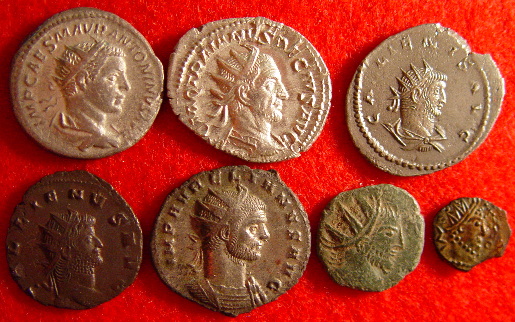

The four denominations in one table
| Denomination | Module | Weight | Period | Tell |
|---|---|---|---|---|
| Denarius | 17–20 mm | 3.0–3.5 g (early), down to 2.7 g (late) | Late Republic to mid-3rd c. | Silver, laureate emperor right, classical reverse types |
| Sestertius | 25–34 mm | 22–28 g | 1st–3rd c. (mainly 1st–2nd) | Large brass / orichalcum, S C on reverse |
| Antoninianus | 20–24 mm | 3.5–4.5 g (silver), later debased | AD 215–290s | Radiate (spiked) crown on emperor |
| Nummus / follis | 13–20 mm | 1.5–3.5 g (varies wildly) | 4th c., mainly 296–402 | Diademed bust right, small bronze, mintmark in exergue |
The denarius
The denarius was the standard silver coin of the Roman Republic and early Empire. UK detector finds tend to cluster in the 1st and 2nd centuries AD — conquest-era issues of Claudius, then the Flavians, Trajan, Hadrian, Antoninus Pius, Marcus Aurelius. A well-struck denarius shows a laureate emperor right on the obverse and one of the classical reverse types (a personification of a virtue, the emperor on horseback, a temple, a captive figure).
- Module 17–20 mm, weight 3–3.5 g.
- Silver. Even when toned dark grey, the silver tone is recognisable.
- Laureate, not radiate. A radiate crown means you’re looking at an antoninianus, not a denarius.
- Legend reads
IMP CAES [emperor name] AVGon the obverse and a virtue or commemoration on the reverse.
The sestertius
The big brass workhorse of early imperial coinage. UK detector finds of sestertii are usually 1st–2nd century. The diagnostic is unmistakeable: a large 25–34 mm brass / orichalcum disc with S Con the reverse — Senatus Consulto, “by decree of the Senate”. That mark only ever appears on senatorial bronze (sestertius, dupondius, as), never on imperial silver or gold.
The antoninianus
Caracalla introduced the antoninianus in AD 215 as a double denarius, worth 2 denarii but containing only about 1.5 denarii of silver. The single most reliable diagnostic is the radiate (spiked) crownon the emperor — laurel for the denarius, radiate for the antoninianus. The denomination became the standard silver of the 3rd century and was progressively debased until the late Gallic Empire issues are essentially bronze with a thin silver wash.
The 3rd-century crisis produced enormous quantities of “barbarous radiates” — local British and Continental imitations of antoniniani struck during the breakaway Gallic Empire (Postumus, Victorinus, Tetricus I and II). These are extremely common UK finds, often crude in style, usually 14–19 mm, and almost always with traces of the radiate crown surviving.
- Radiate crown— confirms antoninianus.
- Module 20–24 mmfor well-struck issues; as small as 12–16 mm for crude barbarous radiates.
- Silver or debased silver on early issues; copper alloy with silver wash on late and Gallic Empire issues.
- Reece period 13 (260–275) is the typical British find context.
The nummus (late Roman bronze)
Diocletian’s reform of 296 introduced a new fractional bronze called the nummus or follis. Module starts at ~25 mm and shrinks steadily through the 4th century to ~13–15 mm by the Valentinianic period. These are the small bronzes that flood Romano-British sites — particularly Reece Period 17 (Constantinian, 330–348) and Reece Period 19 (Valentinianic, 364–378).
Common nummus reverse types
| Reverse type | Description | Reece period |
|---|---|---|
| VRBS ROMA | Helmeted bust left + wolf and twins (Romulus & Remus) reverse | RP 17 (330–340) |
| CONSTANTINOPOLIS | Helmeted bust + Victory on prow | RP 17 (330–340) |
| GLORIA EXERCITVS (two standards) | Two soldiers flanking two military standards | RP 17 (330–337) |
| GLORIA EXERCITVS (one standard) | Two soldiers flanking one standard | RP 17 (337–348) |
| FEL TEMP REPARATIO (falling horseman) | Soldier spearing fallen rider | RP 18 (348–361) |
| GLORIA ROMANORVM | Emperor dragging captive | RP 19 (364–378) |
| SECVRITAS REIPVBLICAE | Victory walking left | RP 19 (364–378) |
Reading the reverse type and matching it to the table almost always gives you the decade. Combine that with the bust style (diademed head, laureate, military) and the emperor name in the obverse legend (CONSTANTINVS, CONSTANTIVS, VALENS, etc.) and the attribution falls out.
Reading a mintmark
From the late 3rd century onwards, late Roman bronzes carry a mintmark in the exergue (the space below the reverse design). UK finds skew heavily to the western mints: Trier, Lyon, London, Arles. Eastern mints are scarce.
| Mintmark | City | Period |
|---|---|---|
| LON / PLN / PLON | London (Londinium) | 296–325 |
| TR / TRS / STR / PTR | Trier | 294–early 5th c. |
| LVG / PLVG / RLVG | Lyon (Lugdunum) | 274 onwards |
| ARL | Arles (Arelate) | 313 onwards |
| SIS / ASIS / BSIS | Siscia | 270 onwards |
| RP / PR / R* | Rome | continuously |
| THES / TES | Thessalonica | 298 onwards |
| CON / CONS | Constantinople | 326 onwards |
The Reece periods in one breath
Richard Reece’s chronological framework groups Roman coins into 21 (now 23) periods covering specific emperors and coin-type profiles. The two periods that dominate UK detector finds:
- Reece Period 13 (260–275)— the barbarous radiates of the Gallic Empire. Tiny, crude, radiate crown. Often illegible legends.
- Reece Period 17 (330–348)— Constantinian small bronzes. VRBS ROMA, CONSTANTINOPOLIS, GLORIA EXERCITVS. The single most common identifiable Roman coin from UK detecting.
Procedural identification — Roman coin
- Module + weight→ ballpark denomination per the table above.
- Crown type on the bust. Laureate = denarius or early imperial bronze. Radiate (spiky) = antoninianus or barbarous radiate. Diademed (pearl band) = late Roman 4th century.
- Reverse type. Match to the table for late bronzes. For sestertii, look for
S Cin the field. - Legend. The emperor’s name in the obverse legend, even partially visible, narrows the date.
- Mintmark on the late bronzes, in the exergue under the reverse design.
Try DetectID on a real find
Upload a photo, add anything you measured, and we’ll return a calibrated shortlist with period, denomination, ruler and reasoning chain — the same diagnostic logic the guide above is built on.
Identify a find